
Dustin A. Lewis is a scholar of international law and an institutional leader whose work examines peace and war through the lens of international law. His research explores both the content of international legal rules and the conditions under which they can provide meaningful protection.
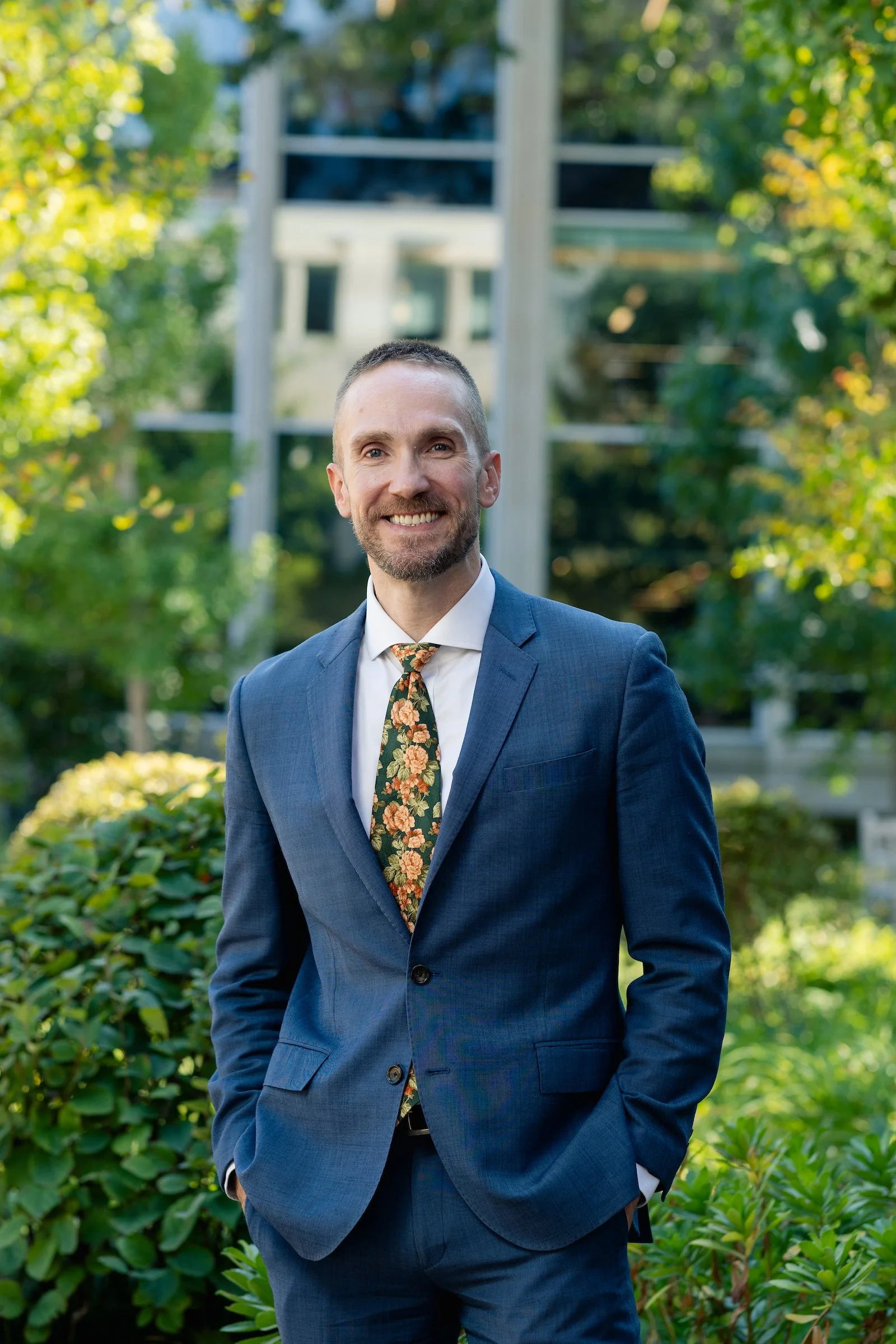
Credit: Lorin Granger.
As Research Director of Harvard Law School’s Program on International Law and Armed Conflict (HLS PILAC), Lewis leads studies on legal and policy questions arising from contemporary armed conflicts. Across his scholarship, he examines what international law requires, permits, and prohibits, as well as how legal obligations are interpreted and implemented in practice. Throughout his work, Lewis seeks to combine doctrinal rigor with careful attention to the consequences that legal and policy decisions have for people affected by war.
Lewis builds research initiatives, legal-reference resources, and international dialogues intended to help strengthen international law’s capacity to prevent and end wars, to protect civilians, persons hors de combat, and the natural environment in armed conflict, and to uphold accountability for violations. At HLS PILAC, he has developed widely used catalogues of Article 51 self-defense reports and Security Council practice concerning environmental protection during armed conflict, directed major collaborative research projects, and supervised more than 200 Harvard Law School student researchers. Lewis regularly organizes and participates in high-level briefings, expert consultations, and multilateral dialogues with governments, U.N. bodies, military institutions, humanitarian and human-rights organizations, and other communities concerning complex questions of international law.
A central focus of Lewis’s recent research concerns the relationships between human judgment, legal responsibility, and emerging technologies. He has developed analytical frameworks that examine how international legal obligations are performed when States rely on artificial intelligence, autonomous weapons, and cyber capabilities. He has also convened senior workshops on those issues and related topics, such as military applications in outer space. He is a co-author of Exercising Cognitive Agency: A Legal Framework Concerning Natural and Artificial Intelligence in Armed Conflict (2025), which proposes a framework for understanding how legal obligations remain grounded in human legal agency as AI becomes increasingly integrated into military and humanitarian decision-making.
Across his broader scholarship, Lewis has developed legal theories concerning the end of contemporary armed conflicts, explored conditions for respecting international law in wars involving advanced technologies, and addressed legal principles underlying impartial medical care for adversaries, including individuals designated as terrorists. He has also examined international legal frameworks meant to enable principled humanitarian action during armed conflict, including humanitarian exemptions to sanctions and counterterrorism measures. In addition, Lewis has written extensively on questions concerning the U.N. Security Council, such as its role in relation to the use of force, sanctions, self-defense, humanitarian action, and civilian protection.
Lewis is an Associate Senior Researcher in the Governance of Artificial Intelligence Program at the Stockholm International Peace Research Institute (SIPRI) and serves on the Independent Advisory Board on Legal Reviews operating under the auspices of the Responsible by Design Institute. He is an honors graduate of Harvard College (A.B.) and Utrecht University School of Law (LL.M.).
Biography last updated: August 2026.
Contact
E-mail: dlewis@law.harvard.edu.
Select Publications
HLS PILAC
Reports, Briefings, Papers, and Commentaries
“State Reliance on AI for Humanitarian Activities in Armed Conflict: Framing Initial IHL-related Considerations,” HLS PILAC, July 2026 (co-author with Taha Wiheba)
“International Law and State Allegations of Double Standards: A Conceptual Analysis,” HLS PILAC, April 2025
“Exercising Cognitive Agency: A Legal Framework Concerning Natural and Artificial Intelligence in Armed Conflict,” HLS PILAC, January 2025 (co-author with Hannah Sweeney)
“Resolution 2664 (2022) and Counterterrorism Measures: An Analytical Frame for States,” HLS PILAC, March 2024 (co-author with Radhika Kapoor and Naz K. Modirzadeh)
“An Interpretive Note for U.N. Member States on Security Council Resolution 2664 (2022),” HLS PILAC, March 2023 (co-author with Radhika Kapoor and Naz K. Modirzadeh)
“Advancing Humanitarian Commitments in Connection with Countering Terrorism: Exploring a Foundational Reframing concerning the Security Council,” HLS PILAC, December 2021 (co-author with Radhika Kapoor and Naz K. Modirzadeh)
“Taking into Account the Potential Effects of Counterterrorism Measures on Humanitarian and Medical Activities: Elements of an Analytical Framework for States Grounded in Respect for International Law,” HLS PILAC, May 2021 (co-author with Naz K. Modirzadeh)
“Preparing for a Twenty-Four-Month Sprint: A Primer for Prospective and New Elected Members of the United Nations Security Council,” HLS PILAC, December 2020 (co-author with Will Ossoff and Naz K. Modirzadeh)
“Three Pathways to Secure Greater Respect for International Law concerning War Algorithms,” Legal Commentary, HLS PILAC, 2020
“The Counter-Terrorism Committee Executive Directorate and International Humanitarian Law: Preliminary Considerations for States,” Legal Briefing, HLS PILAC, March 2020 (co-author with Naz K. Modirzadeh and Jessica S. Burniske); see a related blog entry on Lawfare
“Quantum of Silence: Inaction and Jus ad Bellum,” HLS PILAC, July 2019 (co-author with Naz K. Modirzadeh and Gabriella Blum) (including Annex of apparent “article 51 communications”)
“Armed Non-State Actors and International Human Rights Law: An Analysis of the Practice of the U.N. Security Council and the U.N. General Assembly,” HLS PILAC, June 2017 (co-author with Jessica S. Burniske and Naz K. Modirzadeh)
“Indefinite War: Unsettled International Law on the End of Armed Conflict,” Legal Briefing, HLS PILAC, February 2017 (co-author with Gabriella Blum and Naz K. Modirzadeh); see also a related Lawfare post
“War-Algorithm Accountability,” Research Briefing, HLS PILAC, August 2016 (co-author with Gabriella Blum and Naz K. Modirzadeh). See also related Lawfare post and PHAP Expert Briefing question-and-answer
“Suppressing Foreign Terrorist Fighters and Supporting Principled Humanitarian Action: A Provisional Framework for Analyzing State Practice,” Briefing Report, HLS PILAC, October 2015 (co-author with Jessica Burniske and Naz K. Modirzadeh)
“Medical Care in Armed Conflict: International Humanitarian Law and State Responses to Terrorism,” Legal Briefing, HLS PILAC, September 2015 (co-author with Naz K. Modirzadeh and Gabriella Blum). See also related Lawfare post; Lawfare podcast; Bill of Health Blog post; and PHAP Online Expert IHL Briefing
Compilations, Catalogues, Databases, and Finding Aids
“HLS PILAC Catalogue of Practice of the U.N. Security Council Concerning the Environment, 1945–2021, With an Accompanying Finding Aid” (Editors: Radhika Kapoor and Dustin A. Lewis), HLS PILAC, April 2023
“A Compilation of Materials Apparently Reflective of States’ Views on International Legal Issues pertaining to the Use of Algorithmic and Data-reliant Socio-technical Systems in Armed Conflict” editor, HLS PILAC, December 2020
“Annex — HLS PILAC Catalogue of Communications to the Security Council of Measures Taken by United Nations Member States in Purported Exercise of the Right of Self-Defense: October 24, 1945 through December 31, 2018,” editor, HLS PILAC, July 2019
“Database of States’ Statements (August 2011–November 2016) concerning Use of Force in Relation to Syria,” project director, HLS PILAC, May 2017
“International Counterterrorism Efforts: An Initial Mapping,” editor and project director, HLS PILAC, February 2015
Case-Study Simulation Exercises
“Civilian Protection in Partnered Conflicts: Case-Study Simulation Exercise,” Harvard Law School Case Studies Program, October 2018 (co-author)
“Somalia in Crisis: Famine, Counterterrorism, and Humanitarian Aid: Case-Study Simulation Exercises,” Harvard Law School Case Studies Program, February 2015 (co-author):
Part A: General Background Document
Part B1: The National Security Council Dilemma
Part B2: The NGO General Counsel Dilemma
Other Research and Policy Publications
Chapters in Edited Volumes
On “Responsible A.I.” in War: Exploring Preconditions for Respecting International Law in Armed Conflict, in The Cambridge Handbook of Responsible Artificial Intelligence: Interdisciplinary Perspectives (Silja Voeneky, Philipp Kellmeyer, Oliver Mueller, and Wolfram Burgard eds., Cambridge University Press, 2022)
Preconditions for Applying International Law to Autonomous Cyber Capabilities, in Autonomous Cyber Capabilities under International Law (Rain Liivoja and Ann Väljataga eds., NATO Cooperative Cyber Defence Centre of Excellence, 2021)
Jurisdictional Arrangements and International Criminal Procedure, in International Criminal Procedure: Principles and Rules (Göran Sluiter, Håkan Friman, Suzannah Linton, Sergey Vasiliev, and Salvatore Zappalà eds., Oxford, 2013), pp. 116–128, published as part of the International Criminal Procedure Expert Framework (co-author, with Sarah M. H. Nouwen)
Journal Articles, Opinion Notes, and Position Papers
“The practice of the UN Security Council pertaining to the environment and armed conflict, 1945–2021,” International Review of the Red Cross (2023) (co-author, with Radhika Kapoor)
“War Crimes Involving Autonomous Weapons: Responsibility, Liability and Accountability,” Journal of International Criminal Justice (2023) (Special Issue on autonomous weapons and responsibility issues edited by Paola Gaeta and Marta Bo)
“Responsible reliance concerning development and use of AI in the military domain,” 25 Ethics and Information Technology 8 (2023) (co-author, with Vincent Boulanin)
“Humanitarian values in a counterterrorism era,” 103 International Review of the Red Cross 403 (2021) (co-author with Naz K. Modirzadeh)
“International legal regulation of the employment of artificial-intelligence-related technologies in armed conflict,” Moscow Journal of International Law No. 2, pp. 53–64 (2020)
“The notion of ‘protracted armed conflict’ in the Rome Statute and the termination of armed conflicts under international law: An analysis of select issues,” 101 International Review of the Red Cross 1091 (2020)
“Humanitarian engagement under counter-terrorism: a conflict of norms and the emerging policy landscape,” 93 International Review of the Red Cross 623 (Sept. 2011) (co-author)
“Unrecognized Victims: Sexual Violence against Men in Conflict Settings under International Law,” 27 Wisconsin International Law Journal 1 (2009)
In Proceedings
A Key Set of IHL Questions concerning AI-supported Decision-making, in 51 Collegium (Proceedings of the Bruges Colloquium) 80 (Autumn 2021)
“Criminalization” of Humanitarian Action under Counterterrorism Frameworks: Key Elements and Concerns, 112 American Society of International Law Proceedings 268 (2018)
Floor, Sword, Compass, Shield: Evaluating the Contribution of the 1977 Additional Protocols to the Respect of Medical Activities in Line with Medical Ethics, in 48 Proceedings of the Bruges Colloquium 37 (2018)
Humanitarian Exemptions from Counter-terrorism Measures: A Brief Introduction, in 47 Proceedings of the Bruges Colloquium 141 (2017)
United Nations Audiovisual Library of International Law
“The End of an Armed Conflict under International Law,” Codification Division of the United Nations Office of Legal Affairs, U.N. Audiovisual Library of International Law, lecture (Dec. 12, 2022)
Humanitarian Practice Network Paper
“Counter-terrorism laws and regulations: what aid agencies need to know,” Humanitarian Practice Network Paper, Overseas Development Institute, No. 79, November 2014 (co-author)
Counterterrorism and Humanitarian Engagement Project Research and Policy Papers
“An Analysis of Contemporary Counterterrorism-related Clauses in Humanitarian Grant and Partnership Agreement Contracts,” Research and Policy Paper, Counterterrorism and Humanitarian Engagement Project, May 2014 (unattributed)
“An Analysis of Contemporary Anti-Diversion Policies and Practices of Humanitarian Organizations,” Research and Policy Paper, Counterterrorism and Humanitarian Engagement Project, May 2014 (unattributed)
Working Group Briefing Memoranda
Katie King with Naz K. Modirzadeh and Dustin A. Lewis, “Understanding Humanitarian Exemptions: U.N. Security Council Practice and Principled Humanitarian Action,” Working Group Briefing Memorandum, Counterterrorism and Humanitarian Engagement Project, April 2016
Select Blog Posts
“The U.N. Security Council Adopts a Standing Humanitarian ‘Carve-out’,” Lawfare, December 13, 2022 (co-author)
“An Enduring Impasse on Autonomous Weapons,” Just Security, Sept. 28, 2020
“AI and Machine Learning Symposium: Why Detention, Humanitarian Services, Maritime Systems, and Legal Advice Merit Greater Attention,” Opinio Juris Blog, April 28, 2020
“Counterterrorism and Humanitarian Action: Will 2020 Be a Turning Point for International Humanitarian Law at the United Nations?,” Lawfare, March 31, 2020 (co-author)
“Legal reviews of weapons, means and methods of warfare involving artificial intelligence: 16 elements to consider,” Humanitarian Law and Policy Blog, March 21, 2019
“Expert views on the frontiers of artificial intelligence and conflict,” Humanitarian Law and Policy Blog, March 19, 2019 (co-author)
“The Pentagon’s New Algorithmic-Warfare Team,” Lawfare, June 26, 2017 (co-author)
“Indefinite War,” Lawfare, February 27, 2017 (co-author)
“Accountability for Algorithmic Autonomy in War,” Lawfare, September 12, 2016 (co-author)
“Amid Investigations of Hospital Bombings, Don’t Lose Sight of Key Principles,” Lawfare, October 30, 2015 (co-author)
“PILAC Report on Wartime Medical Care for Terrorists,” Bill of Health Blog, October 5, 2015
“Medical Care in Armed Conflict: IHL and State Responses to Terrorism,” Lawfare, September 8, 2015 (co-author)